

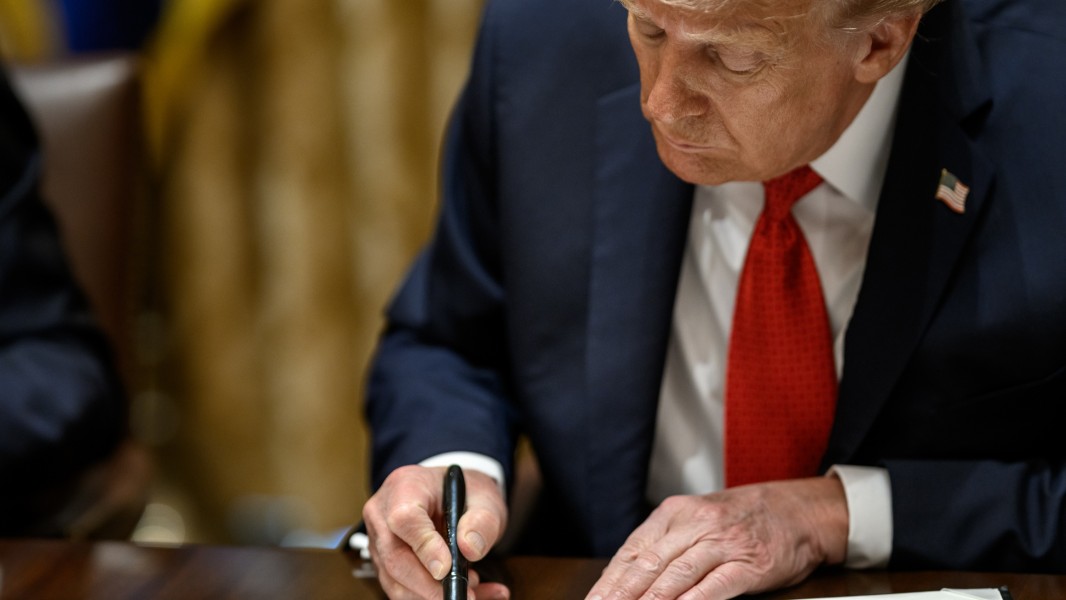
In this edition of Critical Thinking, Peter Hütte analyzes the paradigm shift that occurred in 2025, when President Trump recast critical minerals as a matter of national security.
Last year marked a paradigm shift in the critical minerals space, as supply concentration collided with a more assertive policy environment. In the United States, critical minerals were recast as a national security and industrial resilience priority. The Trump administration adopted elements of China’s playbook – deploying public capital, leaning on strategic procurement and offtake mechanisms, and openly embracing selective protectionism. Washington also treated minerals as a foreign-policy issue, pursuing minerals partnerships with allies including Australia, Ukraine, and Japan.
China, meanwhile, showed how quickly concentration becomes leverage when markets are thin and substitution is limited. Export controls and licensing regimes introduced in April and October – targeting rare earths and magnet-related inputs – shifted the operational question for companies across the globe from “Is there supply?” to “Can we access it, on what terms, for how long and with which partners?”
The US approach also exposed tensions within its own strategy. Signals of stronger government support were offset by policy reversals that weakened confidence in parts of the battery value chain, including rollbacks affecting EV-related incentives and the cancellation of battery-related Department of Energy grants.
Rather than a settled doctrine, the minerals agenda that emerged in 2025 can be best understood as a powerful but still incoherent and opportunistic set of tools and priorities that has elevated critical minerals into the top tier of US economic security concerns. This year we will see the first real tests of whether these individual moves deliver tangible results along the supply chain and begin to add up to a more coherent minerals strategy.
Against this backdrop, we expect several themes to shape 2026:
Volatility remains a structural feature of the critical minerals landscape. Trade friction between the US and China, export controls, and sudden policy shifts will continue to impact procurement. Demand drivers – electrification, data centers, grid-scale storage, renewables, and defense modernization – continue to expand, raising the operational cost of disruptions even when geology is not the constraint.
The national security narrative hardens. Minerals are increasingly treated as strategic assets and bargaining chips. Expect more dealmaking tied to security relationships, including in the Middle East, where governments are positioning across mining, processing, and downstream manufacturing. Greenland offers another example: US attention to the island’s mineral potential and strategic location is likely to intensify, blending security interests with resource ambitions. Whether this translates into concrete moves – through changes in defense posture, strategic financing, or new corporate entries – the signal is the same: in 2026, minerals will sit more squarely inside broader security debates.
Focus broadens beyond rare earths. US attention is likely to expand toward high-risk, under-discussed inputs such as antimony and tungsten, where the US relies heavily on imports and alternatives are limited. Both minerals are essential to defense and industrial supply chains and are sourced largely from China and Russia. Minerals like these that matter strategically but lack public awareness are likely to move up on the policy agenda.
Processing becomes the center of gravity. The emerging consensus in Washington is clear: extraction alone does not create resilience if refining, separation, and component manufacturing remain offshore. The real contest with Beijing in 2026 remains in the midstream, where China’s advantages in cost, scale, and supply chain integration are greatest. The US has a limited bench of mining and processing firms that are able to execute at scale internationally, which raises the importance of partnering with allied incumbents and using public finance to stimulate private sector investment.
Resource nationalism deepens in Africa and Latin America. Governments that Washington is courting as alternatives to China are rewriting the terms of engagement. Licenses are increasingly tied to in-country processing, higher state equity, and the option to reopen fiscal terms when prices or politics shift. US- and ally-backed projects will have to compete with Chinese and Gulf offers that bundle capital, infrastructure, and political support – and accept that securing “friendly” supply often comes with significant political and fiscal costs.
The Development Finance Corporation (DFC) plays an even greater role in US minerals statecraft. In late 2025, Congress reauthorized the DFC through 2031, materially increasing its portfolio capacity from US$60 to US$205 billion and establishing new mechanisms for the DFC to invest as an equity partner. The practical implication is that the DFC can play a larger role in structuring projects where debt alone is insufficient – particularly midstream projects with longer ramp-up periods and higher initial execution risk. The DFC leadership has also signaled sharper attention to Latin America and expanded scope for projects in allied higher-income markets such as Canada and Australia.
The White House remains the main driver of US minerals strategy. Last year revealed a willingness to “pick winners” through high-profile deals, including direct or quasi-equity stakes in companies such as MP Materials and Lithium Americas. Companies that position themselves as credible partners – commercially viable, politically defensible, and aligned with US security goals – are more likely to be pulled into this deal flow. What is less clear is whether these transactions evolve into a more predictable playbook, with standardized offtakes, clearer procurement signals, and risk-sharing tools that investors can apply across multiple projects, or whether minerals policy remains dominated by one-off political exceptions.
For companies, this landscape means treating critical minerals not as a narrow sourcing issue but as a core operating environment. Firms should map their exposure to export controls and policy shifts, qualify alternatives early, and build government engagement into regular decision-making rather than crisis response.